

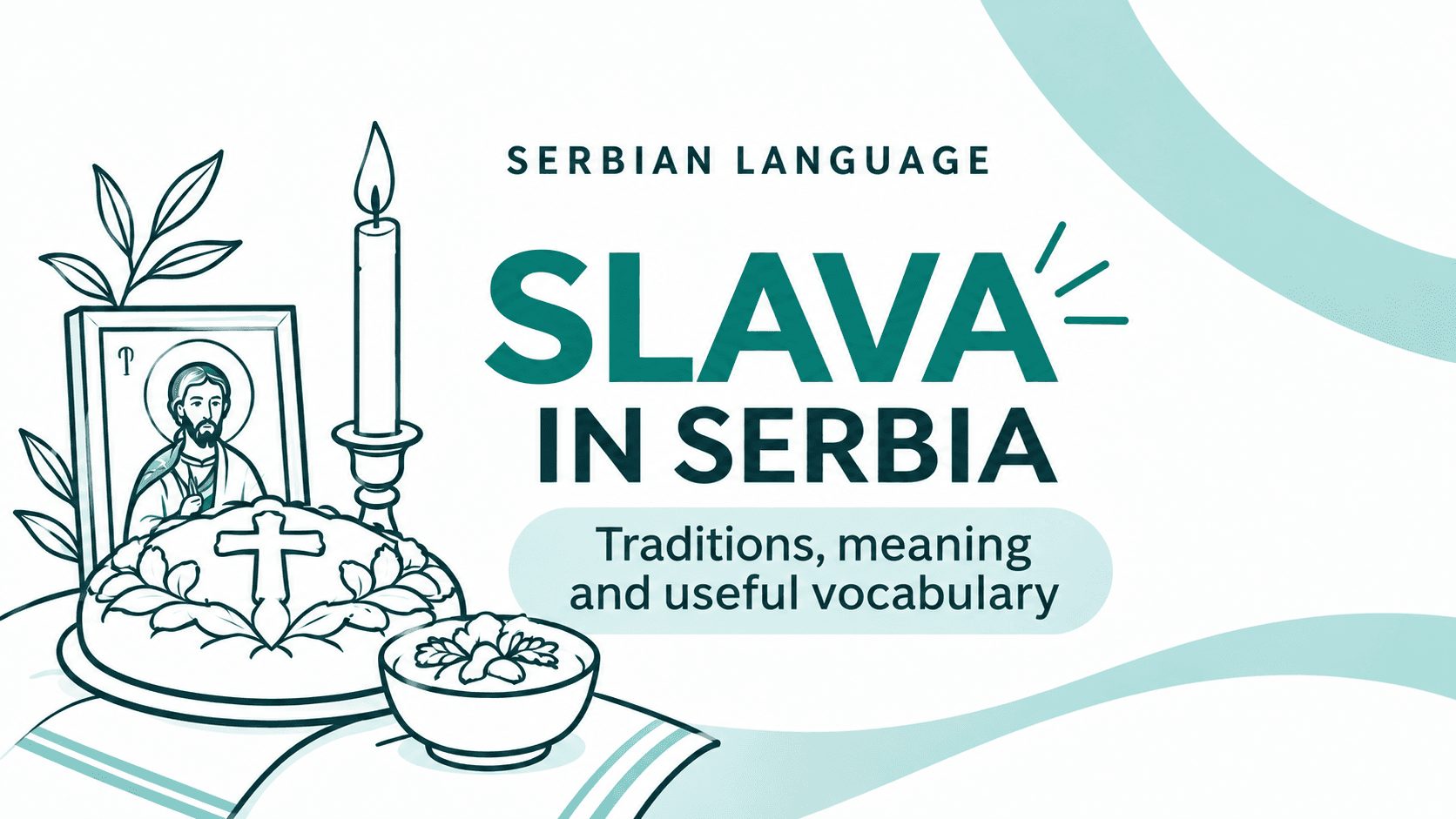
Serbian Slava: What You Need to Know If You're Invited to Celebrate
Why do Serbs celebrate a holiday that doesn't appear on the calendar you're used to? Why is boiled wheat served at the festive table, and what should you say to your hosts instead of simply “Congratulations”? We explore one of Serbia's most important traditions and learn practical Serbian you can actually use in everyday life.
What Is Slava, and Why Is It So Important to Serbs?
Krsna slava (крсна слава) is an Orthodox Christian family celebration honoring a family's patron saint.
Unlike Christmas or Easter, which have dates in the church calendar, each family has its own patron saint and its own celebration day.
Slava is traditionally passed down from generation to generation. It's more than an excuse to gather relatives around a big table: it's an important link to a family's history.
For example:
Свети Никола — Saint Nicholas.
Свети Јован Крститељ — Saint John the Baptist.
Свети Георгије — Saint George.
Свети архангел Михаило — Saint Michael the Archangel.
One of the best-known celebrations is Никољдан (Nikoljdan), Saint Nicholas Day, observed on December 19.
There's even a joke in Serbia:
„Пола Србије слави, а пола иде на славу.“
“Half of Serbia is celebrating Slava, and the other half is visiting someone else's Slava.”
That's an exaggeration, of course, but it shows just how widespread the tradition is.
In 2014, Serbian family Slava was inscribed on UNESCO's Representative List of the Intangible Cultural Heritage of Humanity.
Mini Vocabulary List
Serbian | English |
|---|---|
Крсна слава | Family patron saint celebration |
Светац заштитник | Patron saint |
Славити славу | To celebrate Slava |
Домаћин / домаћица | Host / hostess |
Обичај | Custom |
Наслеђивати | To inherit, pass down |
Породична традиција | Family tradition |
Useful phrase:
„Коју славу славите?“ — Which Slava does your family celebrate?
This is a completely natural question in Serbia. You might hear it from colleagues, neighbors, or new acquaintances.
Five Symbols of Slava: What Does Each One Mean?
When you visit a home for Slava, you'll notice several essential or traditionally significant items. Each carries a special meaning.
1. Славско жито — Ceremonial Wheat Dish
Славско жито (slavsko žito), also known as кољиво (koljivo), is boiled wheat usually mixed with sugar or honey and ground walnuts.
It looks like a sweet dessert, but its meaning goes much deeper.
In Christian tradition, wheat symbolizes resurrection and eternal life. Preparing žito is also associated with prayerful remembrance of the deceased and wishes for the family's well-being.
In many homes, guests are offered žito at the beginning of their visit.
Useful words:
Пшеница — Wheat.
Ораси — Walnuts.
Кувано жито — Boiled wheat.
Кашичица — Teaspoon.
„Да ли сте пробали славско жито?“ — Have you tried Slava wheat?
2. Славски колач — More Than Just Bread
The name can be confusing for Russian speakers.
The Serbian word колач often means “cake” or “sweet pastry,” but slavski kolač is a special ceremonial bread.
It is decorated with dough shapes: a cross, wheat ears, grape clusters, and other symbols. The bread may also bear a seal with the letters ИС ХС НИ КА, a Christian inscription meaning “Jesus Christ conquers.”
One of the central rituals is called ломљење славског колача — the breaking of the Slava bread.
During the ritual, the bread is blessed, sprinkled with wine, turned, and broken. Customs vary: some families perform the ritual in church, while others do so at home.
Useful phrase:
„Баш је лепо украшен славски колач!“ — The Slava bread is beautifully decorated!
3. Црно вино — Why Is Red Wine Called “Black”?
Here's an interesting detail of the Serbian language.
In everyday Serbian, red wine is called црно вино (crno vino), literally “black wine.”
It isn't a different variety or a special production method. It's simply the usual Serbian name.
In Slava rituals, wine symbolizes the blood of Christ and is used when blessing the ceremonial bread.
Remember:
Црно вино — Red wine.
Бело вино — White wine.
Чаша вина — A glass of wine.
Гутљај — A sip.
„Да ли више волите црно или бело вино?“ — Do you prefer red or white wine?
4. Славска свећа — The Candle That Burns on the Celebration Day
A large ceremonial candle is one of Slava's most important symbols.
It is usually lit in the morning. It symbolizes the light of Christ and accompanies prayers, family rituals, and the day's celebration.
In some families, the candle is traditionally extinguished with a little wine at the end of the celebration.
Useful verbs:
Упалити свећу — To light a candle.
Горети — To burn.
Угасити свећу — To extinguish a candle.
Note the difference: свећа means “candle,” while цвеће means “flowers.” Similar-looking words, completely different meanings!
5. Славска икона — The Family's Patron Saint
Traditionally, the home has an icon depicting the saint to whom the Slava is dedicated.
For a religious family, it holds special spiritual significance. The icon serves as a reminder of their patron saint and the spiritual continuity between generations.
Useful question:
„Ко је ваш светац заштитник?“ — Who is your patron saint?
You've Been Invited to Slava. How Should You Behave?
Imagine you've just received an invitation:
„Дођите у суботу код нас на славу.“
“Come to our Slava on Saturday.”
What should you do next?
How Do You Congratulate Your Hosts?
The most important phrase to remember is:
„Срећна слава!“ — Happy Slava!
If you're addressing the whole family, you can say:
„Срећна слава, домаћини!“ — Happy Slava to you, dear hosts!
Another warm expression is:
„Да славите још много година у здрављу и срећи!“
“May you celebrate for many more years in health and happiness!”
What Should You Bring as a Gift?
Expensive gifts generally aren't necessary.
Guests often bring coffee, chocolates, sweets, wine, or a small gift for the home.
One important detail: if Slava falls during a fasting period, the festive menu will be meat- and dairy-free. It's best to take the family's traditions into account when choosing food gifts.
In Serbia, thoughtfulness and respect for your hosts matter more than a gift's price.
Useful words:
Поклон — Gift.
Донети поклон — To bring a gift.
Скроман поклон — Modest gift.
Цвеће — Flowers.
Домаћа кафа — Traditional homemade coffee.
What Should You Wear?
For a family Slava, neat, presentable clothing is usually appropriate. An evening gown or formal suit is generally unnecessary unless your hosts specify a special dress code.
It all depends on the family, the setting, and the nature of the celebration.
Do You Have to Drink Wine?
No. If you're offered wine but don't drink alcohol, it's perfectly fine to decline politely.
„Хвала, не пијем алкохол.“ — Thank you, I don't drink alcohol.
„Може вода, хвала.“ — Water would be fine, thank you.
Don't feel obliged to eat or drink everything you're offered. What matters is showing respect for your hosts' traditions.
What Do People Eat at a Serbian Slava?
A Serbian festive table is a topic of its own, especially if it's your first time attending a family celebration.
The menu can vary greatly from home to home, but some dishes appear frequently.
Two key expressions to know:
Посна слава — A Slava with a fasting-friendly menu.
Мрсна слава — A Slava where meat and dairy products are permitted.
For example, if the celebration falls on a church fasting day, you may find fish dishes and appetizers without meat, milk, or eggs on the table.
How Does the Meal Begin?
Often the first course is предјело (predjelo) — appetizers.
At a non-fasting Slava, you may see prosciutto-style cured meat, cheeses, kajmak, cold cuts, and salads.
At a fasting Slava, there may be fish, vegetables, beans, and fasting-friendly salads.
Soup or čorba often follows.
Чорба (čorba) is a thick, hearty soup, a familiar part of Serbian cuisine.
What Comes Next?
Serbian name | What it is |
|---|---|
Предјело | Appetizer |
Супа | Soup, usually lighter |
Чорба | Thick, hearty soup |
Пребранац | Baked beans with onions |
Сарма | Stuffed cabbage rolls, often made with sauerkraut leaves |
Печење | Roasted meat, usually cooked in large cuts |
Риба | Fish |
Ситни колачи | Small cakes, cookies, and pastries |
Торта | Cake |
At many Slava celebrations, appetizers and hot dishes are followed by sarma, roast meat (печење), or fish, depending on the menu.
For dessert, cakes and entire trays of ситни колачи — little sweet treats — appear.
By the way, „Прсте да полижеш!“ literally means “You'll lick your fingers!” — the Serbian equivalent of “Finger-licking good!”
„Ова сарма је прсте да полижеш!“ — This sarma is finger-licking good!
Serbian at the Festive Table: Ready-to-Use Phrases for Guests
Textbooks usually teach you how to order coffee in a café. But in real life, you might need to compliment your hostess, politely refuse a second helping, or chat with relatives.
Here's a handy cheat sheet.
Serbian | English |
|---|---|
Хвала на позиву! | Thank you for inviting us! |
Драго ми је што смо дошли. | We're glad we could come. |
Све изгледа прелепо! | Everything looks wonderful! |
Баш је укусно! | It's really delicious! |
Могу ли да добијем рецепт? | Could I have the recipe? |
Само мало, хвала. | Just a little, thank you. |
Хвала, већ сам сит / сита. | Thank you, I'm already full. (masculine / feminine) |
Нисам никад пробао / пробала ово. | I've never tried this before. (masculine / feminine) |
Баш нам је било лепо! | We had a wonderful time! |
Хвала на гостопримству! | Thank you for your hospitality! |
A Short Dialogue
Домаћица: Изволите, пробајте сарму!
Hostess: Please, help yourself to some sarma!
Гост: Хвала! Баш лепо мирише. Да ли сте је ви правили?
Guest: Thank you! It smells wonderful. Did you make it yourself?
Домаћица: Јесам. Хоћете још мало?
Hostess: I did. Would you like some more?
Гост: Хвала, за сада је довољно. Све је веома укусно!
Guest: Thank you, that's enough for now. Everything is delicious!
Notice the phrase „Хоћете још мало?“ — “Would you like some more?” You may hear it more than once during a meal with a Serbian family!
Let's Check How Well You've Understood the Traditions
Knowing vocabulary is good. Being able to use it in conversation is even better.
Try these short exercises. They're suitable for beginners as well as those who already speak Serbian with some confidence.
Exercise 1. Level A1 — Congratulate Someone Correctly
Fill in the correct form of the adjective срећан (“happy”).
______ рођендан!
______ слава!
______ Божић!
______ Нова година!
______ празници!
______ венчање!
Hint: In Serbian, adjectives agree with nouns in gender and number.
Exercise 2. Levels A1–A2 — Recognize the Symbols
Match each description with the Serbian word.
Words: свећа, жито, икона, колач, црно вино.
Ceremonial bread decorated with shapes made of dough.
A dish made from boiled wheat and walnuts.
Burns throughout the celebration day.
An image of the family's patron saint.
Used when blessing the ceremonial Slava bread.
Exercise 3. Level A2 — Riddles in Serbian
Read each description and guess the word.
A. Ја сам слатко јело од куване пшенице. Често имам орахе и шећер. Шта сам ја?
B. Ја горим на славском столу и симболизујем светлост. Шта сам ја?
C. Могу да будем посна или мрсна. Правим се од купуса и пуњења. Шта сам ја?
Exercise 4. Levels B1–B2 — Translate Real-Life Situations
Translate into Serbian:
Thank you for inviting us to your Slava!
Which saint does your family celebrate?
Could I have a little water?
Everything is delicious, especially the sarma.
We had a wonderful time. Thank you for your hospitality!
Answers to all exercises are at the end of the article.
Small Cultural Details That Help You Understand Serbia
Here's an interesting detail: Slava is a family celebration, but it's also a very social event.
Some homes welcome several generations of relatives, while others invite friends and neighbors too. Colleagues may wish each other a happy Slava, and close acquaintances often know the dates of one another's family celebrations.
Still, there is no single script that every Slava follows. Some families strictly observe traditional rituals, while others focus more on the family meal. Recipes, celebration length, and guest-invitation customs all vary.
That's why, when learning the language, it's useful not only to memorize the names of traditions but also to ask how they work in a particular family.
The question „Како ви славите славу?“ — “How does your family celebrate Slava?” — can start a fascinating conversation.
Learning Serbian Also Means Learning to Understand People
You might know Serbian cases perfectly and still feel lost when you're invited to your first Slava.
Or you might know only a few simple expressions and already feel more confident at the festive table.
At Nisam Stranac, that's exactly the kind of Serbian we teach: language that helps you understand traditions, talk to neighbors and colleagues, meet people, ask questions, and gradually feel at home in Serbia.
In our lessons, we cover not only grammar but also real-life conversations, cultural customs, and the expressions you hear every day.
Want to do more than study Serbian — want to actually use it in everyday life?
Join a free trial lesson at Nisam Stranac. We'll help you choose a convenient learning format — online or in person in Novi Sad.
Exercise Answers
Exercise 1:
Срећан рођендан!
Срећна слава!
Срећан Божић!
Срећна Нова година!
Срећни празници!
Срећно венчање!
Exercise 2:
Славски колач.
Славско жито.
Славска свећа.
Славска икона.
Црно вино.
Exercise 3:
A — жито; B — свећа; C — сарма.
Exercise 4 — Possible Answers:
Хвала на позиву на славу!
Ког свеца слави ваша породица?
Могу ли да добијем мало воде?
Све је веома укусно, посебно сарма.
Баш нам је било лепо. Хвала на гостопримству!